4C NEED TO KNOW Food Waste Management
Top Tip: Knowing about the impact of food waste on our climate and what really happens when you throw food away helps understand WHY reducing food waste is so important – here is where to start.
First Complete: 4A: Food Waste Management Survey
Solutions for each school will be based on your answers to the Survey. As part of that survey, you have answered:
- How much waste was generated by the school on a daily and weekly basis?
- What percentage of the waste is food waste, paper, plastic, metal, or other?
- Where can you make a difference in the waste generated by the school?
Here is more general information on how to improve food waste management:
“Food waste” is any food or inedible parts of food removed from the food supply chain to be recovered or disposed of1. About one third of all food produced globally – 1.6 billion tons – is lost or wasted along the management chain2. This wastes resources and makes recyclable materials in the waste stream harder to recover. The way to tackle this problem is through prevention, then reduction, and then recycling, recovery, and disposal of waste.
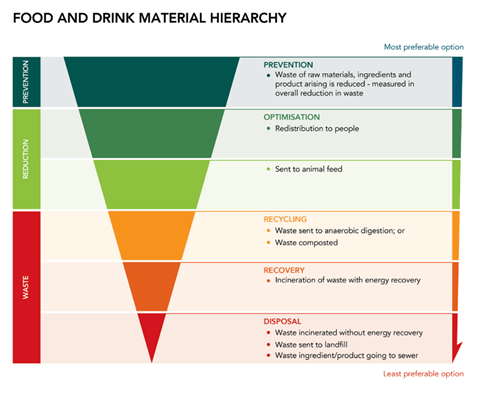
C40 and World Biogas Association Global Food Waste Management Executive Summary2
The first consideration is to prevent the over-generation of food in the first place through demand side and supply side mechanisms. For example, create demand for a plant-rich diet through information campaigns that is matched by what is offered in the cafeteria. Although meat is only 5% of waste it represents over 20% of embodied GHGs. Edible unused food can be donated and redistributed to other parts of the community instead of being disposed of. The table below shows just how little GHGs are recovered compared to donations.
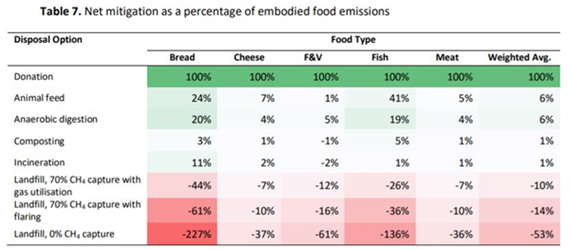
Food waste that still remains can be processed to recover soil nutrients and reduce GHGs. The ways food waste are processed include composting, anaerobic digestion (AD), incineration and some recovery at landfill. Each has a different performance in terms of energy and nutrient recovery, water management, building soil organic matter, and contributing positively to climate change solutions in general. Regardless, it is important to collect organic waste separately from other waste streams such as plastic, so that food waste can be measured, awareness raised, and contamination of waste streams prevented.
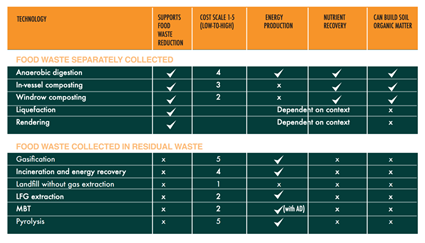
C40 and World Biogas Association Global Food Waste Management Executive Summary2
Composting is a waste disposal method in which waste decomposes natural under oxygen-rich conditions. Compost, sometimes called humus, is nutrient-rich and can be used to fertilize school gardens. Gasification uses a series of thermo-chemical reactions to converts food waste into a gaseous combustible gas, sometimes called producer gas or syngas. Pyrolysis chemically decomposes food waste at very high temperatures (above 430 degrees Celsius) in the absence of oxygen. It irrevocably changes the chemical composition of the food waste and leaves a solid residue enriched in carbon called char.
One way to address necessary food waste is to use it for Anaerobic Digestion (AD) to generate biogas. This biogas can be used to generate electricity and heat instead of relying on fossil fuels sources. AD is the natural breakdown or organic matter to produce biogas. A co-product of AD is biofertilizer, which can be used in school gardens to improve soil health and plant growth.
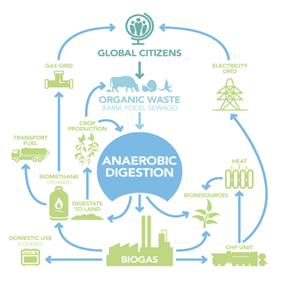
C40 and World Biogas Association Global Food Waste Management Executive Summary2
Here is more information on what happens to your non-food waste, that is paper, plastic, metal and other waste.
Recycling is a complicated and sometimes imperfect process of converting waste materials into new materials which ideally promotes the reduction of raw materials and limits energy use and pollution. But it has often been falsely heralded as the solution to plastic pollution. It is not that simple. Recycling is a hugely energy-intensive process and can still be very polluting.
It takes 75% less energy to make a plastic bottle from recycled plastic compared with using ‘virgin’ materials. Using a tonne of recycled plastic bottles (recycled PET or recycled HDPE) in new bottles saves around a tonne of CO2eq. These statistics are from WRAP.
Therefore, your efforts should be focused on first refusing and then reducing and reusing plastic, and then recycling
At many schools, a lack of understanding about why and how we separate waste can create cross-contamination of bins on campus.
If general unrecyclable waste gets mixed in with recyclable waste, it usually means (depending on the waste provider) that all the recyclables are contaminated and will all be classified as general waste. Therefore, it is important to only throw recyclables in the recycling bin to ensure everything gets recycled.
Here are some ideas to encourage better recycling practices on campus:
- Location of the bins on campus: make sure these are in areas of high “foot traffic” or near vending points.
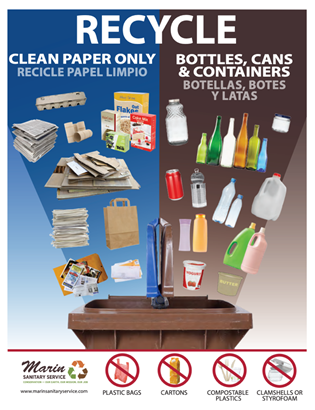
- Better labelling on bins: make sure that it is absolutely clear what goes into each bin. This can be done with photos of commonly consumed items as well as items sold directly on campus. Source
- Bin Busters (either members of the EcoCrew or volunteers) can direct the flow of waste regularly to explain to people where waste goes and why.
- Regular bin audits to track the effectiveness of recycling and to identify areas high in contamination. These can also help with getting key data to communicate to the school community, e.g. “1 out of every 3 recycling bins was cross-contaminated with general waste”.
References
1 C40 and World Biogas Association Global Food Waste Management Executive Summary
2 FAO “Global Food Waste Management: An Implementation Guide for Cities”